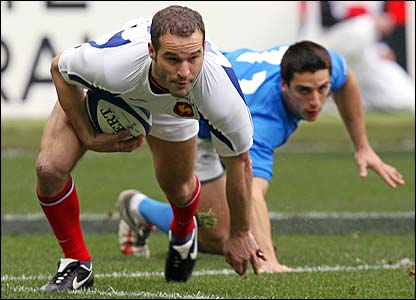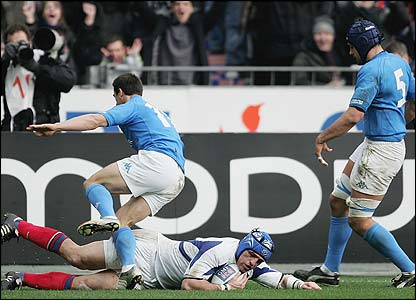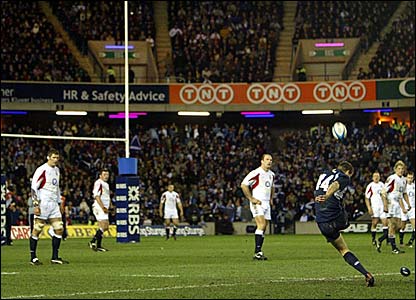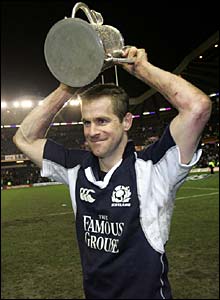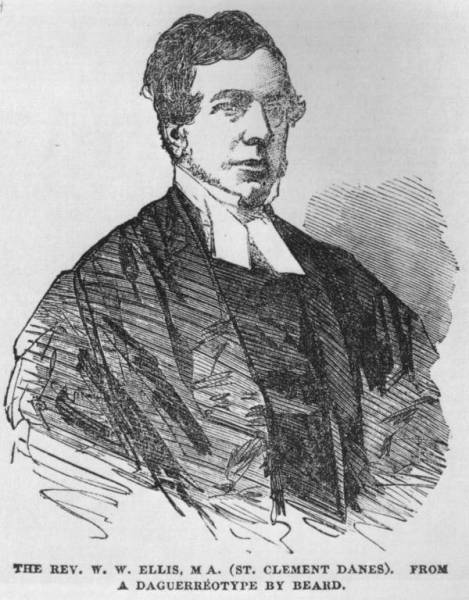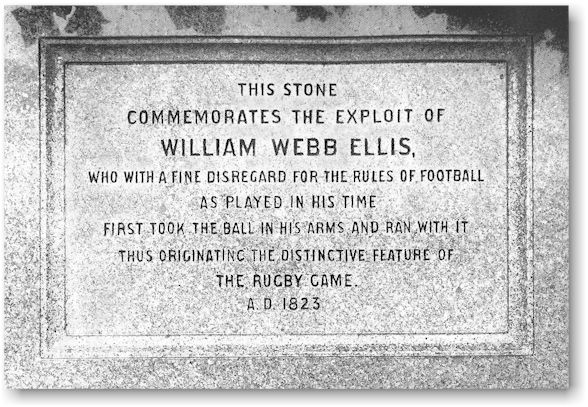
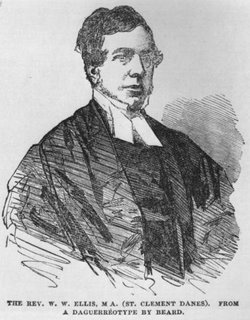
The story goes that while playing soccer at Rugby School in 1823, William Webb Ellis picked up the ball in his hands and ran with it. Well, that's the story I grew up with, and the myth has stood the test of time His name is revered enough to have had the Rugby World Cup trophy named after him, and it is the story most people are familiar with.
However, it does seem that games similar to rugby had been played many years, if not centuries prior to 1823.
At that time he was in Rugby School, Webb Ellis' father was stationed in Ireland with the Dragoons turning good Catholics into terrorists (you would have thought we would have learnt by now), and where, it is said, he would have witnessed the native game of Caid (Cad). Could it be that he may have passed details of this game on to his son? All branches of the Celtic race played Caid. There were two basic forms, Cross-country cad and field cad. The word 'Caid' means scrotum of the bull.
The Welsh say that Caid was just a derivative of their sport of Criapan. The Cornish called it "hurling to goales" which dates back to the bronze age, the West country called it "hurling over country", East Anglians "Campball", the French "La Soule" or "Chole" (a rough-and-tumble cross-country game). In fact, there had been traditions of ball-in-hand sports games for centuries before Webb Ellis' was born.
However, a more formalised game was played at Rugby School which appears to have led to the creation of the game we recognise today. Cambridge University immediately adopted the game, popularised it and made local rules. The game grew more popular and in 1871, ten years after the common rules of soccer were set, the first Rugby Union was founded in London and firm rules of the game were established.

However, in 1895 rugby clubs in northern England called for compensation of lost wages for players. The Rugby League was founded as a result and a 13-player game with altered rules were created for professionals. The history of Rugby League is something I will perhaps return to in the future. But for now, I will concentrate on Rugby Union, - perhaps the most noble and greatest game in the world.
The Mother Of All GamesRugby spread across the globe and competition emerged between countries. In the United States, the game emerged primarily on the West Coast.

The lack of precise rules, ambiguities in the game and complexity of the sport drew a lot of United States players away from the game and major changes were invoked. In 1880 the scrum was replaced by a line of scrimmage, drawing emphasis from the free-running characteristic of the game. The game continued to play with rugby rules until 1905 where the publication of photographs of a harsh game between Sarthmore and Pennsylvania created a stir. President Theodore Roosevelt insisted on reform of the game to lower the brutality with threat of abolishing the game by edict. In 1906 the forward pass was introduced to the United States game. The rules of rugby died and the game of American football was born.
Australian Rules Football can also trace its origin to Rugby School. In 1857, Tom Wills, one of the founders of Australian Football, returned to Australia after schooling in England where he was football captain of Rugby School and a brilliant cricketer and where he would have played the 'new', game of rugby. Initially, he advocated the winter game of football as a way of keeping cricketers fit during off-season.
The Objective Of The Game
The objective of the game is to gain more points than the opposing team within the allotted time of play. A tie is called if the scores are equal at the end of play. A try is scored when a player places the ball on the ground in the opposition's goal area. It is counted as 5 points and can be converted to an additional 2 points with a successful place kick made from a line perpendicular to the point at which the ball was scored over the goal cross-bar and between the uprights. A goal can also be scored through a penalty with a free kick or a drop kick from the field of play in a similar fashion. A goal counts as 3 points. The game is played in halves, with no stoppages or time outs. Play is continuous, and is only halted when a team has scored or a law has been infringed. At which point, a set play is commenced to start the game off again. A really good and in-depth, but straight-forward breakdown of the Laws of Rugby (rugby doesn't have rules) can be found
here.
Why have I written this blog, and spent a long time explaining something about the game? Those of you who
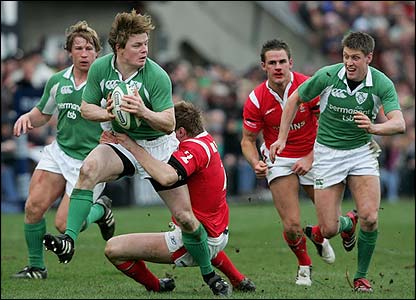
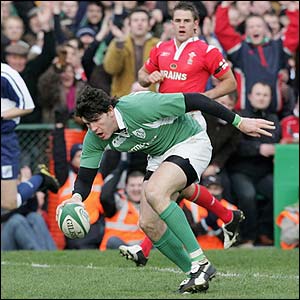
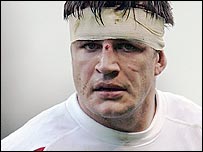
remember me going nuts during the summer when England beat Australia at cricket to win the "Ashes" might have thought that Cricket was "my" game. But no. My first love is rugby. When younger, I played it on a regular basis, - I have the broken nose as proof, and I have always followed it, and this weekend marks the annual start of an international rugbyfest. - the
6 Nations. I will talk about that in a future post later this week.

 the slowest of balls giving Wales time to prepare their defence. The England back line was under constant pressure, and as a result, mistakes were made that Wales capitalised on. When Mike Catt had to leave the field injured, it left England with the youngest and most inexperienced set of backs we've had for a long time, and would have looked to the forwards to give them some protection and time to play. The problem was, that the forwards seemed to be playing as if they had never met each other before!
 the slowest of balls giving Wales time to prepare their defence. The England back line was under constant pressure, and as a result, mistakes were made that Wales capitalised on. When Mike Catt had to leave the field injured, it left England with the youngest and most inexperienced set of backs we've had for a long time, and would have looked to the forwards to give them some protection and time to play. The problem was, that the forwards seemed to be playing as if they had never met each other before!
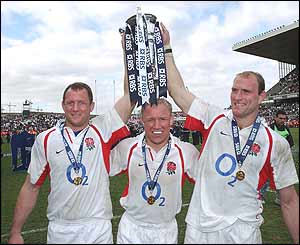
 As a matter of record, France won the 6 Nations Championship by scoring a try in the last seconds of their match against Scotland. That gave them a marginally better points difference to Ireland, who up until that moment, thought they were champions.